
Why digital complexity is undermining efficiency
Author: Amber Lovell
Across the education sector, lenses are focused on curriculum, pedagogy, attendance, behaviour, and staffing. Yet one of the most influential drivers of staff workload and organisational efficiency is something that’s quite frequently overlooked, arguably because of its omniscience and where it sits outside formal strategy discussions: the design of the digital working environment.
Now, the digital working environment isn’t just a place where educators can work, it’s where pupils gain access to a world of knowledge, and teams can access a subsequent world of usage data. Therefore, it’s a no-brainer that digital systems now underpin almost every operational and educational process in many schools and trusts up and down the country.
With elements such as teaching resources, safeguarding records, assessment data, parental communication, reporting, collaboration, and administration all depend on a growing ecosystem of platforms and tools, digital adoption has undoubtedly expanded capability, but it has also introduced a less visible challenge — one that increasingly surfaces in staff workload discussions.
Not technology itself, but digital complexity.
The paradox of plenty
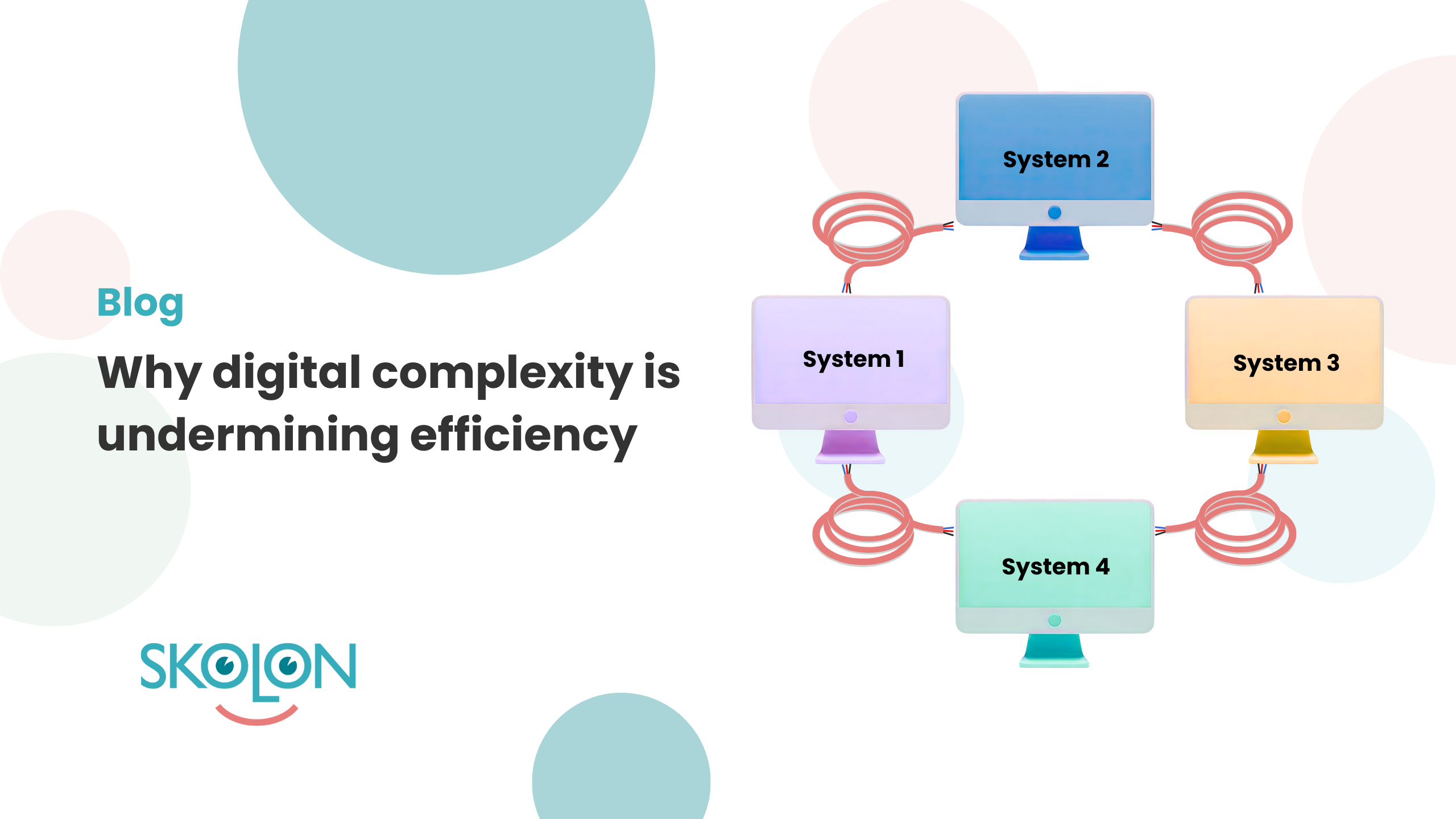
Over the past decade, trusts have understandably invested in specialist solutions; learning platforms, assessment systems, safeguarding software, communication tools, analytics dashboards, and administrative systems and more have often been procured to solve specific problems. Individually, many of these tools perform well. Collectively, however, they can create fragmented workflows, overlapping functionality, inconsistent user experiences, and persistent low-level friction.
This friction rarely appears problematic if systems are functioning and tasks are being completed but no one seems to actually look into how the tasks are being completed and so forth.
For example, staff will frequently navigate between multiple interfaces, duplicate processes across platforms, manage streams of notifications, and spend time locating information rather than acting on it. The result is not always visible inefficiency, but a steady drain on attention and cognitive capacity.

The cognitive cost of digital complexity
Delving deeper, if we may, educational psychology offers a useful framework here.
Cognitive load theory (1988) reminds us that mental resources are finite.
To put it quite simply, when complexity increases unnecessarily, more mental effort is consumed by navigation, switching, and decision-making, leaving less capacity for the professional judgements that matter most.
While this may not be an abstract concern immediately, the Department for Education’s workload reviews have repeatedly highlighted the cumulative burden created by administrative processes, data demands, and system inefficiencies.
Of course, in the context of schools and trusts, these discussions often centre on marking, assessment, and accountability structures, digital infrastructure increasingly plays a significant, if quieter, role in shaping everyday workload.
Research on attention and task switching reinforces the issue. Frequent interruptions, even brief ones triggered by system alerts or platform changes, carry measurable cognitive costs; the recovery of focus is rarely immediate.
Subsequently, over time, fragmented digital environments can contribute to reduced efficiency, increased fatigue, and the perception of constant busyness without proportional progress.
Scale magnifies complexity
For trusts operating at scale, these effects are amplified. Every additional platform introduces not only functionality, but also decisions, training requirements, integration challenges, and workflow implications. The ongoing and increasing complexity rarely distributes evenly; teachers and middle leaders often absorb the practical consequences of system design choices made above them elsewhere.
Importantly, this is not a critique of EdTech investment. Sector research, including DfE-supported EdTech studies, consistently highlights the potential of digital tools to improve efficiency, reduce workload, and enhance learning.
The differentiating factor, however, is rarely the presence of technology, but the coherence of the environment in which it operates.
Well-designed digital ecosystems behave like infrastructure. They recede into the background, enabling work rather than shaping it. Poorly aligned systems, by contrast, compete for attention, introduce duplication, and subtly increase cognitive demand.

From tool selection to system design
As schools and trusts continue to mature their digital strategies, a shift in emphasis is emerging.
Less focus on individual tools as solutions.
Greater focus on system design, workflow coherence, and user experience across the organisation.
It’s this shift that reframes familiar strategic questions.
Instead of asking simply what a platform can do, schools and MATs will increasingly benefit from asking how staff actually move through tasks, where friction accumulates, and whether technology reduces or redistributes workload.
Rationalisation, integration, consistency, and attention-aware design become matters of organisational effectiveness rather than technical optimisation. In a policy landscape defined by workload pressures, retention challenges, and financial constraint, digital design is no longer merely an IT concern. It is a strategic one.
Because one of the most significant barriers to staff efficiency may not be visible in classrooms, timetables, or budgets. It may be embedded in the everyday experience of navigating the digital school day.
In a system already under pressure, complexity is rarely neutral, it almost always becomes workload.
Use the button below to chat with the Skolon team to discuss how trusts are simplifying digital ecosystems to reduce cognitive load and improve day-to-day operational flow.
Information
Author: Amber Lovell
Share this story
Subscribe
Would you like our newest articles delivered to your inbox? Sign up now!
Across the education sector, lenses are focused on curriculum, pedagogy, attendance, behaviour, and staffing. Yet one of the most influential drivers of staff workload and organisational efficiency is something that’s quite frequently overlooked, arguably because of its omniscience and where it sits outside formal strategy discussions: the design of the digital working environment.
Now, the digital working environment isn’t just a place where educators can work, it’s where pupils gain access to a world of knowledge, and teams can access a subsequent world of usage data. Therefore, it’s a no-brainer that digital systems now underpin almost every operational and educational process in many schools and trusts up and down the country.
With elements such as teaching resources, safeguarding records, assessment data, parental communication, reporting, collaboration, and administration all depend on a growing ecosystem of platforms and tools, digital adoption has undoubtedly expanded capability, but it has also introduced a less visible challenge — one that increasingly surfaces in staff workload discussions.
Not technology itself, but digital complexity.
The paradox of plenty
Over the past decade, trusts have understandably invested in specialist solutions; learning platforms, assessment systems, safeguarding software, communication tools, analytics dashboards, and administrative systems and more have often been procured to solve specific problems. Individually, many of these tools perform well. Collectively, however, they can create fragmented workflows, overlapping functionality, inconsistent user experiences, and persistent low-level friction.
This friction rarely appears problematic if systems are functioning and tasks are being completed but no one seems to actually look into how the tasks are being completed and so forth.
For example, staff will frequently navigate between multiple interfaces, duplicate processes across platforms, manage streams of notifications, and spend time locating information rather than acting on it. The result is not always visible inefficiency, but a steady drain on attention and cognitive capacity.
The cognitive cost of digital complexity
Delving deeper, if we may, educational psychology offers a useful framework here.
Cognitive load theory (1988) reminds us that mental resources are finite.
To put it quite simply, when complexity increases unnecessarily, more mental effort is consumed by navigation, switching, and decision-making, leaving less capacity for the professional judgements that matter most.
While this may not be an abstract concern immediately, the Department for Education’s workload reviews have repeatedly highlighted the cumulative burden created by administrative processes, data demands, and system inefficiencies.
Of course, in the context of schools and trusts, these discussions often centre on marking, assessment, and accountability structures, digital infrastructure increasingly plays a significant, if quieter, role in shaping everyday workload.
Research on attention and task switching reinforces the issue. Frequent interruptions, even brief ones triggered by system alerts or platform changes, carry measurable cognitive costs; the recovery of focus is rarely immediate.
Subsequently, over time, fragmented digital environments can contribute to reduced efficiency, increased fatigue, and the perception of constant busyness without proportional progress.
Scale magnifies complexity
For trusts operating at scale, these effects are amplified. Every additional platform introduces not only functionality, but also decisions, training requirements, integration challenges, and workflow implications. The ongoing and increasing complexity rarely distributes evenly; teachers and middle leaders often absorb the practical consequences of system design choices made above them elsewhere.
Importantly, this is not a critique of EdTech investment. Sector research, including DfE-supported EdTech studies, consistently highlights the potential of digital tools to improve efficiency, reduce workload, and enhance learning.
The differentiating factor, however, is rarely the presence of technology, but the coherence of the environment in which it operates.
Well-designed digital ecosystems behave like infrastructure. They recede into the background, enabling work rather than shaping it. Poorly aligned systems, by contrast, compete for attention, introduce duplication, and subtly increase cognitive demand.
From tool selection to system design
As schools and trusts continue to mature their digital strategies, a shift in emphasis is emerging.
Less focus on individual tools as solutions.
Greater focus on system design, workflow coherence, and user experience across the organisation.
It’s this shift that reframes familiar strategic questions.
Instead of asking simply what a platform can do, schools and MATs will increasingly benefit from asking how staff actually move through tasks, where friction accumulates, and whether technology reduces or redistributes workload.
Rationalisation, integration, consistency, and attention-aware design become matters of organisational effectiveness rather than technical optimisation. In a policy landscape defined by workload pressures, retention challenges, and financial constraint, digital design is no longer merely an IT concern. It is a strategic one.
Because one of the most significant barriers to staff efficiency may not be visible in classrooms, timetables, or budgets. It may be embedded in the everyday experience of navigating the digital school day.
In a system already under pressure, complexity is rarely neutral, it almost always becomes workload.
Use the button below to chat with the Skolon team to discuss how trusts are simplifying digital ecosystems to reduce cognitive load and improve day-to-day operational flow.
Share this story
Subscribe
Would you like our newest articles delivered to your inbox? Sign up now!