Meet the Educator: Nicki Hambleton – visualising a new way to learn
Author: Amber Lovell
Welcome back to Meet the Educator – our monthly spotlight series where we share the real stories, insights, and everyday brilliance of educators across the country.
In this edition, we’re going down a slightly different path and venturing into the world of visual thinking and neurodiversity with Nicki Hambleton.
An art teacher of over 30 years, Nicki’s journey has taken her from the classrooms of Italy and Singapore back to the UK, where she now works as an educational consultant and learning coach. Her mission? To prove that learning isn’t just about memorising text… it’s about how we think, draw, and connect!
From the art room to the therapist’s chair
Nicki’s pivot from traditional art teaching to learning coaching was driven by a simple observation: students were working incredibly hard, but many didn’t actually know how they learned.
“In the art room, I’m a people person, so it became like a therapist’s chair. It became apparent that students were just very good at memorising and regurgitating for exams, but they didn’t have strategies. I could see people struggling because they didn’t learn in that one specific way.”
This hit home personally when Nicki’s youngest son faced similar challenges. It sparked a deep dive into research, leading her to create online courses and one-to-one coaching programs that help students “dip into” skills like retrieval practice and revision; long before they reach the pressure cooker of university.
The power of the visual brain hack
Nicki describes herself as an “octopus” with many arms.
One in traditional art, one in digital, and others reaching into business coaching and creative journaling. At the heart of it all is visual thinking.
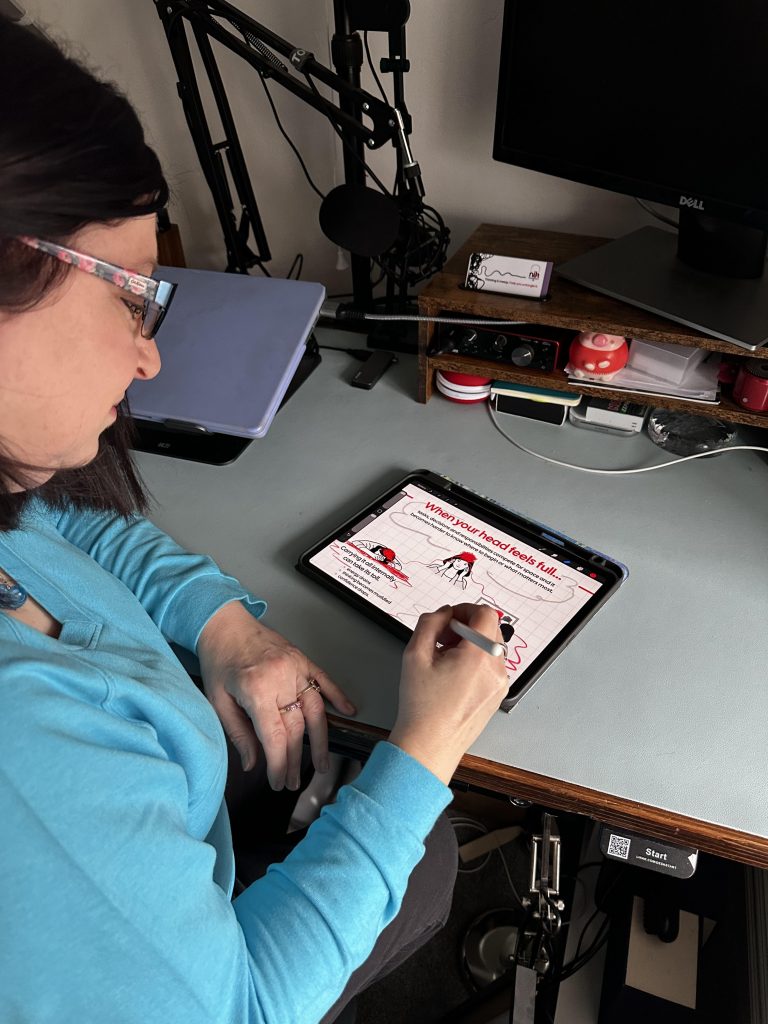
Nicki is a fierce advocate for the iPad, seeing it as the ultimate bridge between the physical and digital worlds.
Dual coding: Combining symbols and text to give the brain two ways to remember information.
The “5-second lightbulb”: Nicki teaches students and adults that you don’t need to be an artist to “draw for thinking.”
Sketch-noting: Using icons and keywords to record meetings or lessons, making notes scannable and memorable.
“Visuals just hack the brain,” Nicki explains.
“If you can make a mark, that’s the beginning of everything. I’m not teaching drawing for drawing’s sake; I’m teaching drawing for thinking.”
Juggling growth, dogs, and AI
A typical day for Nicki starts with a “well-being walk” with her cocker spaniel, before diving into international coaching sessions. Because of the time zones, her mornings are often spent with students in Asia or China, helping them navigate “executive function challenges” and breaking down walls of text into manageable visual maps.
When the conversation turns to AI, Nicki shares a “Marmite” relationship with the tech:
The love: She uses tools like ChatGPT to model “good use” for her students, such as generating German revision questions for a student to check and verify, turning the AI’s output into a learning exercise.
The worry: She fears that AI is being used to do the “leg work” of thinking. “I worry that thinking is being pushed aside. Students will say, ‘Just give me the text,’ but they don’t want to do the hard work of thinking.”
Bridging the gap: human-centered skills
Looking toward the future of education in the UK, Nicki emphasises a balanced diet of technology and “human-centered” skills. She rejects the term “soft skills,” noting that adaptability, emotional intelligence, and communication are the most rigorous and necessary tools for the 2030 workforce.
“We must build humans into the best way they can be in a future we have no idea about. That’s why I love the iPad! You still have to write and draw. We need to be aware of the basics that should still be basic.”
The magic wand: Radical inclusion
If Nicki could wave a magic wand, her answer is twofold. In the short term: Abolish exams.
In the long term, she dreams of a system where the approach fits the child, rather than forcing the child to fit the approach.
“I find it so sad that an individual is born with a challenge they didn’t ask for; be it dyslexia or being an introvert, and it’s not recognised or listened to. I want a level playing field where every struggling individual has their preferred approach so they can build self-esteem and find their superpowers.”
Are you an educator using visual thinking or innovative tech to reach your students? We’d love to hear your story! Email: amber.lovell@skolon.com to be our star!
This is Skolon – we gather the best digital educational tools and make them work in the classroom.
Skolon is an independent platform for digital educational tools and learning resources, created for both teachers and students. With Skolon, accessing and using your digital educational tools is easy – security increases, administration decreases, and there’s more time for learning.
The digital educational tools come from both small and large providers, all of whom have one thing in common – they create digital educational tools that are beneficial for the school environment.
Information
Author: Amber Lovell
Share this story
Subscribe
Would you like our newest articles delivered to your inbox? Sign up now!
Welcome back to Meet the Educator – our monthly spotlight series where we share the real stories, insights, and everyday brilliance of educators across the country.
In this edition, we’re going down a slightly different path and venturing into the world of visual thinking and neurodiversity with Nicki Hambleton.
An art teacher of over 30 years, Nicki’s journey has taken her from the classrooms of Italy and Singapore back to the UK, where she now works as an educational consultant and learning coach. Her mission? To prove that learning isn’t just about memorising text… it’s about how we think, draw, and connect!
From the art room to the therapist’s chair
Nicki’s pivot from traditional art teaching to learning coaching was driven by a simple observation: students were working incredibly hard, but many didn’t actually know how they learned.
“In the art room, I’m a people person, so it became like a therapist’s chair. It became apparent that students were just very good at memorising and regurgitating for exams, but they didn’t have strategies. I could see people struggling because they didn’t learn in that one specific way.”
This hit home personally when Nicki’s youngest son faced similar challenges. It sparked a deep dive into research, leading her to create online courses and one-to-one coaching programs that help students “dip into” skills like retrieval practice and revision; long before they reach the pressure cooker of university.
The power of the visual brain hack
Nicki describes herself as an “octopus” with many arms.
One in traditional art, one in digital, and others reaching into business coaching and creative journaling. At the heart of it all is visual thinking.
Nicki is a fierce advocate for the iPad, seeing it as the ultimate bridge between the physical and digital worlds.
Dual coding: Combining symbols and text to give the brain two ways to remember information.
The “5-second lightbulb”: Nicki teaches students and adults that you don’t need to be an artist to “draw for thinking.”
Sketch-noting: Using icons and keywords to record meetings or lessons, making notes scannable and memorable.
“Visuals just hack the brain,” Nicki explains.
“If you can make a mark, that’s the beginning of everything. I’m not teaching drawing for drawing’s sake; I’m teaching drawing for thinking.”
Juggling growth, dogs, and AI
A typical day for Nicki starts with a “well-being walk” with her cocker spaniel, before diving into international coaching sessions. Because of the time zones, her mornings are often spent with students in Asia or China, helping them navigate “executive function challenges” and breaking down walls of text into manageable visual maps.
When the conversation turns to AI, Nicki shares a “Marmite” relationship with the tech:
The love: She uses tools like ChatGPT to model “good use” for her students, such as generating German revision questions for a student to check and verify, turning the AI’s output into a learning exercise.
The worry: She fears that AI is being used to do the “leg work” of thinking. “I worry that thinking is being pushed aside. Students will say, ‘Just give me the text,’ but they don’t want to do the hard work of thinking.”
Bridging the gap: human-centered skills
Looking toward the future of education in the UK, Nicki emphasises a balanced diet of technology and “human-centered” skills. She rejects the term “soft skills,” noting that adaptability, emotional intelligence, and communication are the most rigorous and necessary tools for the 2030 workforce.
“We must build humans into the best way they can be in a future we have no idea about. That’s why I love the iPad! You still have to write and draw. We need to be aware of the basics that should still be basic.”
The magic wand: Radical inclusion
If Nicki could wave a magic wand, her answer is twofold. In the short term: Abolish exams.
In the long term, she dreams of a system where the approach fits the child, rather than forcing the child to fit the approach.
“I find it so sad that an individual is born with a challenge they didn’t ask for; be it dyslexia or being an introvert, and it’s not recognised or listened to. I want a level playing field where every struggling individual has their preferred approach so they can build self-esteem and find their superpowers.”
Are you an educator using visual thinking or innovative tech to reach your students? We’d love to hear your story! Email: amber.lovell@skolon.com to be our star!
This is Skolon – we gather the best digital educational tools and make them work in the classroom.
Skolon is an independent platform for digital educational tools and learning resources, created for both teachers and students. With Skolon, accessing and using your digital educational tools is easy – security increases, administration decreases, and there’s more time for learning.
The digital educational tools come from both small and large providers, all of whom have one thing in common – they create digital educational tools that are beneficial for the school environment.
Share this story
Subscribe
Would you like our newest articles delivered to your inbox? Sign up now!