From Simplicity to Sovereignty: EdTech Trends of 2025 and Predictions for 2026
With the end of the term creeping closer with the opening of every advent calendar door, we can all agree that now is the perfect time to reflect. As those in the education sector know, be it leaders, teachers and coordinators, the pace of digital change is not slowing down; in fact, the integration of AI and digital tools is only accelerating.
Based on our recent End of Year webinar, here is a wrap-up of the defining trends of 2025 and an insightful look into what 2026 holds for education technology.
2025 Retrospective: The Year of Simplicity and Security
Looking back at 2025, the most unexpected trend wasn’t a single piece of futuristic hardware, but it was arguably a hyperfocus on simplicity.
Vendors realised that to increase adoption, technology had to become easier to use. This led to the rise of prompt-based tools (like ChatGPT and Gemini) and “vibe coding,” where educators could quickly programme AI for inspiration without technical expertise.
However, this push for digital adoption also highlighted critical challenges:
The Trust Crisis: 2025 saw major cloud failures, such as the AWS outage, which had real-world consequences like disrupting water purification systems. This shifted the focus from merely using tech to data sovereignty, which essentially refers to knowing exactly where your data is stored and ensuring it is ring-fenced and GDPR compliant.
The “Aha!” Moment for Teachers: The true breakthrough of 2025 was technology that genuinely reduced administrative burden. Tools like Canva with built-in AI delivered on the promise of freeing up teacher time, allowing them to focus on building one-to-one connections with students rather than late-night marking.
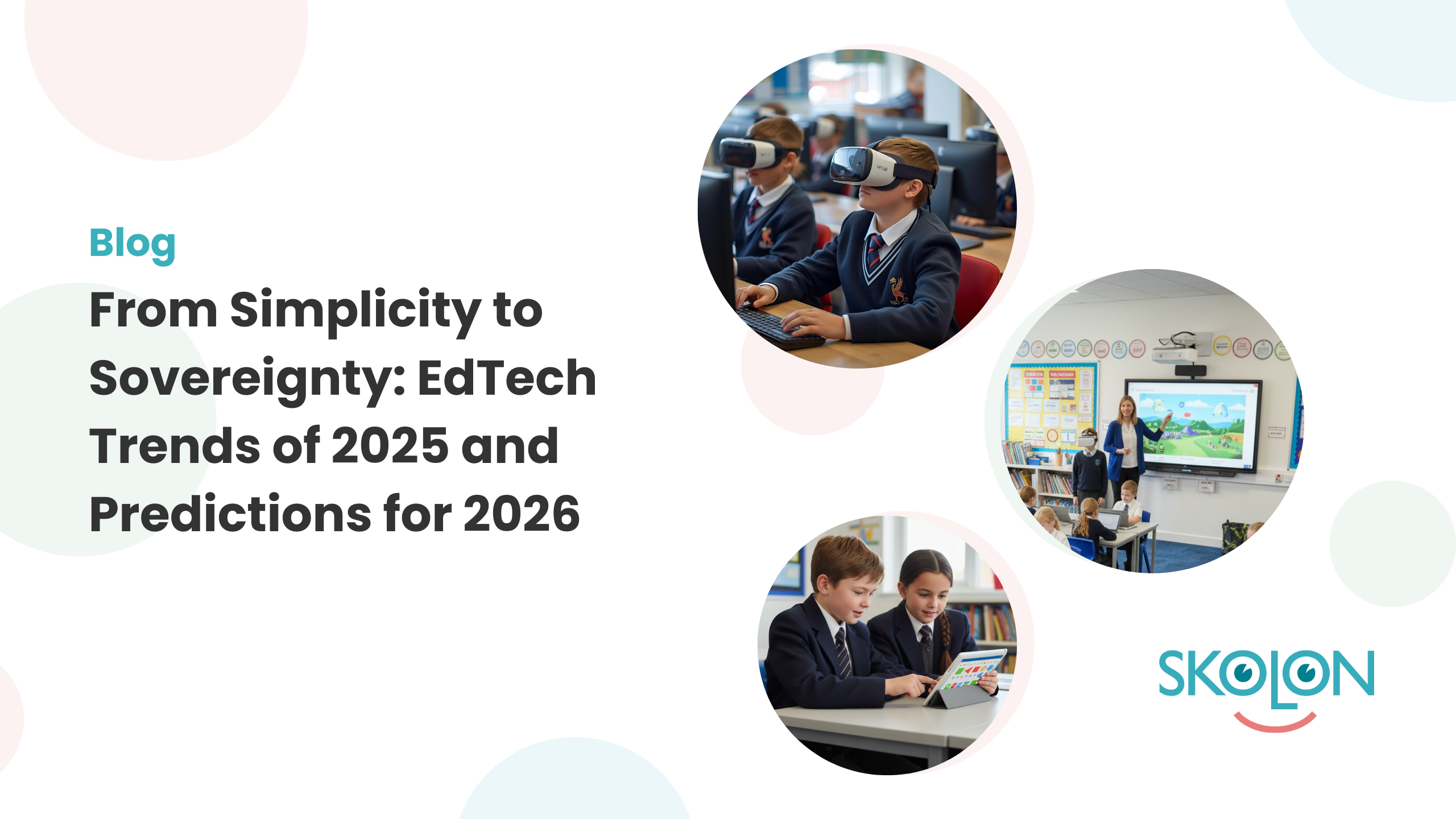
The VR Stumble: While predicted to be huge, Virtual Reality (VR) hit barriers due to the sheer physical effort of managing hardware (charging, updating) and a lack of proven efficiency in learning outcomes.

2026 Predictions: Regulation, Ethics, and Augmented Reality
Moving into 2026, the challenge shifts from keeping up to keeping ahead and future-proofing. The conversation is moving away from the technology itself and toward control, ethics, and infrastructure.
1. The Regulation Tipping Point
The defining factor of 2026 will be laws and ethics. The upcoming AI Act and GDPR will serve as the definitive limits on how technology helps us, rather than just raw capability. Schools are now writing AI policies to govern safe usage, making this a leadership issue rather than just an IT concern.
2. The “George Orwell 1984” Risk
A major topic for 2026 is avoiding the “George Orwell problem”, where advanced AI monitors student interactions or brainwaves so deeply that it breaks down human behaviour. We must avoid creating a society of “superhumans versus workers” by ensuring students are active creators rather than passive spectators.
3. The Battle for Authenticity
With the rise of generative AI comes the acceleration of deep fakes and misinformation. We risk facing a “TikTok election problem” where false content makes it difficult for students to discern truth. Consequently, EdTech in 2026 must focus on empowering source criticism, encouraging students to question AI outputs rather than accepting them as fact.
4. From Screens to Wearables
As mobile phones hit their maximum reach, the next trend is Augmented Reality (AR) and wearables. Unlike VR, which replaces the classroom, AR is predicted to become dominant because it enhances reality, allowing teachers and students to process data faster and make more accurate decisions without being cut off from the real world.

Looking Ahead: Building a Future-Proof Strategy
It can be argued that the riskiest choice you could make for 2026 is spending endless time and money building custom, complicated infrastructures. Instead, a goal should be to invest in a stable core ecosystem that simplifies Single Sign-On (SSO) and provides access to pre-vetted tools.
As the industry moves toward strict regulation and increased focus on data location, establishing data sovereignty is non-negotiable. Skolon offers the clear solution: a platform built for the complexities of modern regulation, giving you full control and transparency over where and how your educational data is stored. It’s the essential “AI guard rail” that allows teachers to use powerful new tools without the “Trust Crisis” risk.
Ensure your school meets the regulatory tipping point of 2026.
Use the button below to discover how Skolon’s trusted platform can simplify compliance and strengthen your fundamental data security.
Information
Share this story
Subscribe
Would you like our newest articles delivered to your inbox? Sign up now!
With the end of the term creeping closer with the opening of every advent calendar door, we can all agree that now is the perfect time to reflect. As those in the education sector know, be it leaders, teachers and coordinators, the pace of digital change is not slowing down; in fact, the integration of AI and digital tools is only accelerating.
Based on our recent End of Year webinar, here is a wrap-up of the defining trends of 2025 and an insightful look into what 2026 holds for education technology.
2025 Retrospective: The Year of Simplicity and Security
Looking back at 2025, the most unexpected trend wasn’t a single piece of futuristic hardware, but it was arguably a hyperfocus on simplicity.
Vendors realised that to increase adoption, technology had to become easier to use. This led to the rise of prompt-based tools (like ChatGPT and Gemini) and “vibe coding,” where educators could quickly programme AI for inspiration without technical expertise.
However, this push for digital adoption also highlighted critical challenges:
The Trust Crisis: 2025 saw major cloud failures, such as the AWS outage, which had real-world consequences like disrupting water purification systems. This shifted the focus from merely using tech to data sovereignty, which essentially refers to knowing exactly where your data is stored and ensuring it is ring-fenced and GDPR compliant.
The “Aha!” Moment for Teachers: The true breakthrough of 2025 was technology that genuinely reduced administrative burden. Tools like Canva with built-in AI delivered on the promise of freeing up teacher time, allowing them to focus on building one-to-one connections with students rather than late-night marking.
The VR Stumble: While predicted to be huge, Virtual Reality (VR) hit barriers due to the sheer physical effort of managing hardware (charging, updating) and a lack of proven efficiency in learning outcomes.
2026 Predictions: Regulation, Ethics, and Augmented Reality
Moving into 2026, the challenge shifts from keeping up to keeping ahead and future-proofing. The conversation is moving away from the technology itself and toward control, ethics, and infrastructure.
1. The Regulation Tipping Point
The defining factor of 2026 will be laws and ethics. The upcoming AI Act and GDPR will serve as the definitive limits on how technology helps us, rather than just raw capability. Schools are now writing AI policies to govern safe usage, making this a leadership issue rather than just an IT concern.
2. The “George Orwell 1984” Risk
A major topic for 2026 is avoiding the “George Orwell problem”, where advanced AI monitors student interactions or brainwaves so deeply that it breaks down human behaviour. We must avoid creating a society of “superhumans versus workers” by ensuring students are active creators rather than passive spectators.
3. The Battle for Authenticity
With the rise of generative AI comes the acceleration of deep fakes and misinformation. We risk facing a “TikTok election problem” where false content makes it difficult for students to discern truth. Consequently, EdTech in 2026 must focus on empowering source criticism, encouraging students to question AI outputs rather than accepting them as fact.
4. From Screens to Wearables
As mobile phones hit their maximum reach, the next trend is Augmented Reality (AR) and wearables. Unlike VR, which replaces the classroom, AR is predicted to become dominant because it enhances reality, allowing teachers and students to process data faster and make more accurate decisions without being cut off from the real world.
Looking Ahead: Building a Future-Proof Strategy
It can be argued that the riskiest choice you could make for 2026 is spending endless time and money building custom, complicated infrastructures. Instead, a goal should be to invest in a stable core ecosystem that simplifies Single Sign-On (SSO) and provides access to pre-vetted tools.
As the industry moves toward strict regulation and increased focus on data location, establishing data sovereignty is non-negotiable. Skolon offers the clear solution: a platform built for the complexities of modern regulation, giving you full control and transparency over where and how your educational data is stored. It’s the essential “AI guard rail” that allows teachers to use powerful new tools without the “Trust Crisis” risk.
Ensure your school meets the regulatory tipping point of 2026.
Use the button below to discover how Skolon’s trusted platform can simplify compliance and strengthen your fundamental data security.
Share this story
Subscribe
Would you like our newest articles delivered to your inbox? Sign up now!