The power of perspective: Why Side-by-Side AI is a global first, powered by Skolup
Try as you might, but you can’t avoid AI…
…it’s absolutely everywhere (even in places it shouldn’t be) and it has become an indispensable tool across countless industries and aspects of our daily lives, with data cementing its usage by highlighting that 500 – 600 million people use AI daily around the world.
From personalised recommendations to complex data analysis and creative content generation, the uses and applications of AI are seemingly endless. However, as AI tools become more ubiquitous, a critical question arises:
How can we ensure that we are using them responsibly and effectively, while avoiding the pitfalls of bias and limited perspective that threatens the very foundation of objective learning and independent thought?
The dangers of a single source
Delving deeper, a limited perspective occurs when a learner is exposed to only one way of thinking or a single data source, which can result in an incomplete understanding of a topic and the unintended reinforcement of “echo chambers”, further contributing to the passive nature of the next generation.
Coupled with the proliferation of different AI models, each with its unique strengths, weaknesses, and training data, we, as AI users are presented with a challenge for users seeking accurate and well-rounded information. Furthermore, relying on a single AI model can lead to single-source bias, where the output reflects the specific limitations or inherent biases of that particular system.
This can be especially problematic in fields like education, and research, where critical thinking and diverse viewpoints are paramount.
So, what needs to change in order to ensure we aren’t just creating faster students, but smarter, more discerning ones?
The answer lies in transparency and triangulation.
To truly safeguard the integrity of learning, we must move away from the “black box” approach, where a single AI provides a single, unchallenged answer, and instead embrace a multi-model environment.

From passive consumption to active evaluation
In practice, this means providing tools that allow users to interrogate the AI as much as the AI informs them. By seeing how different algorithms interpret the same prompt, students and researchers can identify where the consensus lies and where individual model biases begin. This shift from a single truth to a multi-model critique is exactly what we must facilitate to move the next generation from passive consumption to active, critical evaluation.
Addressing this challenge head-on is Skolup, Skolon’s innovative AI integration platform designed specifically for the educational sector.
Our unique Side-by-Side AI feature provides users with an unprecedented perspective by allowing them to compare and contrast the responses of multiple leading models, including GPT-4, Mistral, and Gemini, within a single interface. This groundbreaking capability, a global first, empowers educators and students to move beyond the limitations of single-model interactions and cultivate the essential critical thinking skills required for an AI-driven world.
Demystifying AI models and combating bias
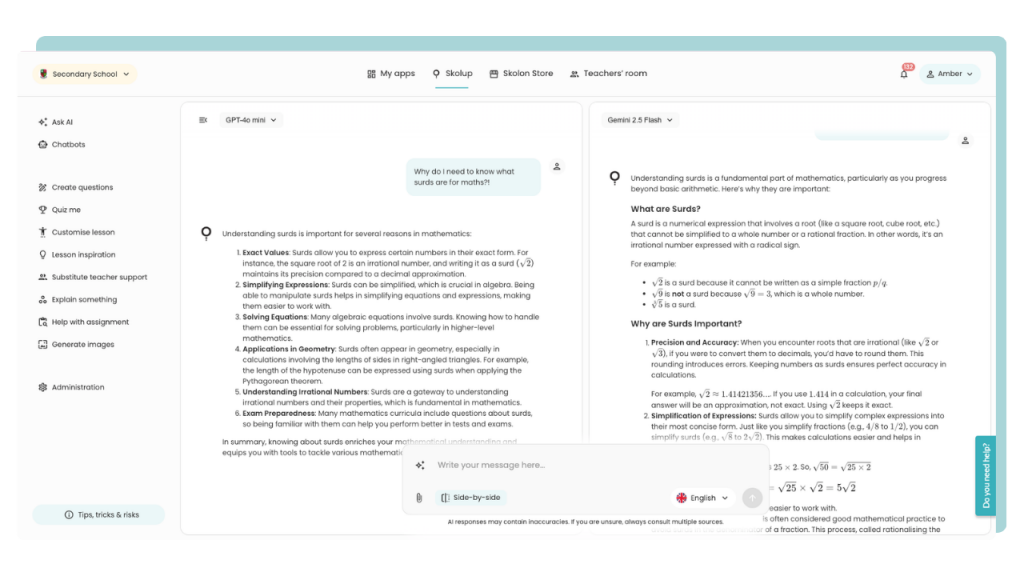
The concept of Side-by-Side AI is as simple as it is profound. For example, when a user pops in a prompt or question, Skolup simultaneously processes it through multiple AI models that you as the user have the ability to choose.
The resulting responses are displayed in adjacent panels, offering a unique opportunity for comparison and evaluation.
Can’t picture it?
No worries, we’ll show you.
In this example, a history teacher asks the AI about the causes of the French Revolution.
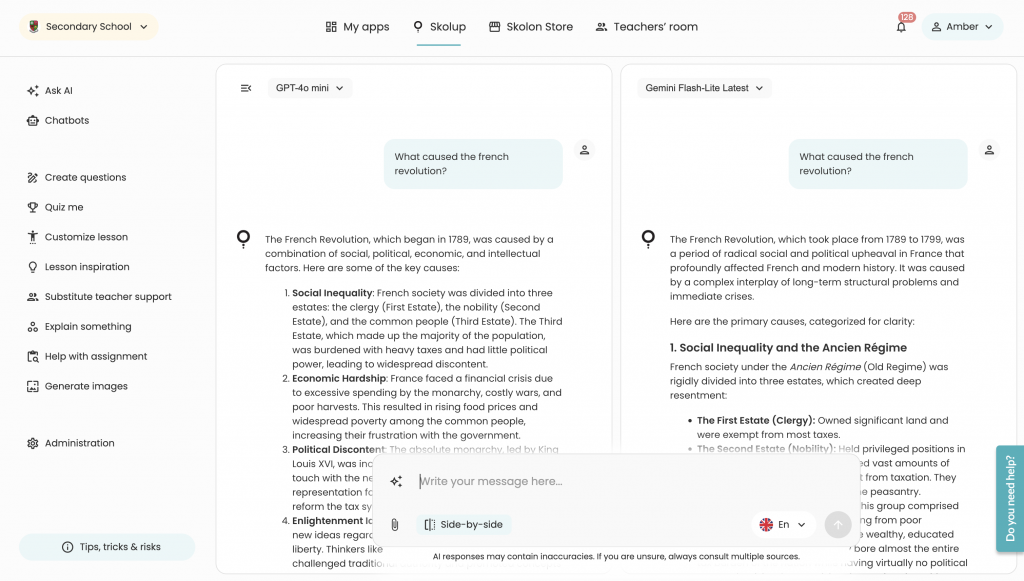
With Side-by-Side AI, they can immediately compare how GPT-4 provides a shorter summary of causes, while Gemini Flash Lite highlights social inequalities in greater detail.
This distinct perspective reveals that no single AI model holds all the answers and that the complexity of real-world issues requires exploring diverse viewpoints.
This comparison tool is particularly powerful in fostering critical thinking, in line with the DfE’s new curriculum to give young people the skills for life and work.
By presenting multiple perspectives, Skolup encourages users to actively evaluate the information they receive, question underlying assumptions, and identify potential biases. Students, for instance, can analyse how different AI models approach a literary passage, highlighting variations in tone, interpretation, and emphasis.
This process not only deepens their understanding of the subject matter, but also equips them with crucial analytical skills for navigating an information-rich world.
Cultivating critical thinkers in the AI age
Skolup’s commitment to promoting diverse perspectives extends beyond the confines of the classroom. With Skolup, we address the broader concern about the potential for AI to reinforce existing biases or create informational silos.
By providing a platform for comparing multiple AI models, Skolup actively combats single-source bias and encourages a more nuanced and critical approach to AI-generated information.
Hitherto, Side-by-Side AI serves as a powerful educational tool for understanding the very nature of AI itself. By observing how different models respond to the same prompt, users gain insights into their underlying training data, algorithms, and potential limitations. This fosters transparency and builds trust in AI technologies, essential for their responsible and effective integration across various domains.
In conclusion, Skolup’s Side-by-Side AI feature represents a significant leap forward in AI integration for education and beyond. By providing unprecedented perspective and fostering critical thinking, Skolup empowers users to harness the full potential of AI while navigating its complexities with confidence and discernment. As we move deeper into the AI age, cultivating a diverse and critical perspective is more crucial than ever, and Skolup is leading the way.
Information
Share this story
Subscribe
Would you like our newest articles delivered to your inbox? Sign up now!
Try as you might, but you can’t avoid AI…
…it’s absolutely everywhere (even in places it shouldn’t be) and it has become an indispensable tool across countless industries and aspects of our daily lives, with data cementing its usage by highlighting that 500 – 600 million people use AI daily around the world.
From personalised recommendations to complex data analysis and creative content generation, the uses and applications of AI are seemingly endless. However, as AI tools become more ubiquitous, a critical question arises:
How can we ensure that we are using them responsibly and effectively, while avoiding the pitfalls of bias and limited perspective that threatens the very foundation of objective learning and independent thought?
The dangers of a single source
Delving deeper, a limited perspective occurs when a learner is exposed to only one way of thinking or a single data source, which can result in an incomplete understanding of a topic and the unintended reinforcement of “echo chambers”, further contributing to the passive nature of the next generation.
Coupled with the proliferation of different AI models, each with its unique strengths, weaknesses, and training data, we, as AI users are presented with a challenge for users seeking accurate and well-rounded information. Furthermore, relying on a single AI model can lead to single-source bias, where the output reflects the specific limitations or inherent biases of that particular system.
This can be especially problematic in fields like education, and research, where critical thinking and diverse viewpoints are paramount.
So, what needs to change in order to ensure we aren’t just creating faster students, but smarter, more discerning ones?
The answer lies in transparency and triangulation.
To truly safeguard the integrity of learning, we must move away from the “black box” approach, where a single AI provides a single, unchallenged answer, and instead embrace a multi-model environment.
From passive consumption to active evaluation
In practice, this means providing tools that allow users to interrogate the AI as much as the AI informs them. By seeing how different algorithms interpret the same prompt, students and researchers can identify where the consensus lies and where individual model biases begin. This shift from a single truth to a multi-model critique is exactly what we must facilitate to move the next generation from passive consumption to active, critical evaluation.
Addressing this challenge head-on is Skolup, Skolon’s innovative AI integration platform designed specifically for the educational sector.
Our unique Side-by-Side AI feature provides users with an unprecedented perspective by allowing them to compare and contrast the responses of multiple leading models, including GPT-4, Mistral, and Gemini, within a single interface. This groundbreaking capability, a global first, empowers educators and students to move beyond the limitations of single-model interactions and cultivate the essential critical thinking skills required for an AI-driven world.
Demystifying AI models and combating bias
The concept of Side-by-Side AI is as simple as it is profound. For example, when a user pops in a prompt or question, Skolup simultaneously processes it through multiple AI models that you as the user have the ability to choose.
The resulting responses are displayed in adjacent panels, offering a unique opportunity for comparison and evaluation.
Can’t picture it?
No worries, we’ll show you.
In this example, a history teacher asks the AI about the causes of the French Revolution.
With Side-by-Side AI, they can immediately compare how GPT-4 provides a shorter summary of causes, while Gemini Flash Lite highlights social inequalities in greater detail.
This distinct perspective reveals that no single AI model holds all the answers and that the complexity of real-world issues requires exploring diverse viewpoints.
This comparison tool is particularly powerful in fostering critical thinking, in line with the DfE’s new curriculum to give young people the skills for life and work.
By presenting multiple perspectives, Skolup encourages users to actively evaluate the information they receive, question underlying assumptions, and identify potential biases. Students, for instance, can analyse how different AI models approach a literary passage, highlighting variations in tone, interpretation, and emphasis.
This process not only deepens their understanding of the subject matter, but also equips them with crucial analytical skills for navigating an information-rich world.
Cultivating critical thinkers in the AI age
Skolup’s commitment to promoting diverse perspectives extends beyond the confines of the classroom. With Skolup, we address the broader concern about the potential for AI to reinforce existing biases or create informational silos.
By providing a platform for comparing multiple AI models, Skolup actively combats single-source bias and encourages a more nuanced and critical approach to AI-generated information.
Hitherto, Side-by-Side AI serves as a powerful educational tool for understanding the very nature of AI itself. By observing how different models respond to the same prompt, users gain insights into their underlying training data, algorithms, and potential limitations. This fosters transparency and builds trust in AI technologies, essential for their responsible and effective integration across various domains.
In conclusion, Skolup’s Side-by-Side AI feature represents a significant leap forward in AI integration for education and beyond. By providing unprecedented perspective and fostering critical thinking, Skolup empowers users to harness the full potential of AI while navigating its complexities with confidence and discernment. As we move deeper into the AI age, cultivating a diverse and critical perspective is more crucial than ever, and Skolup is leading the way.
Share this story
Subscribe
Would you like our newest articles delivered to your inbox? Sign up now!