Empowering teachers digitally with BookWidgets
Author: Amber Lovell
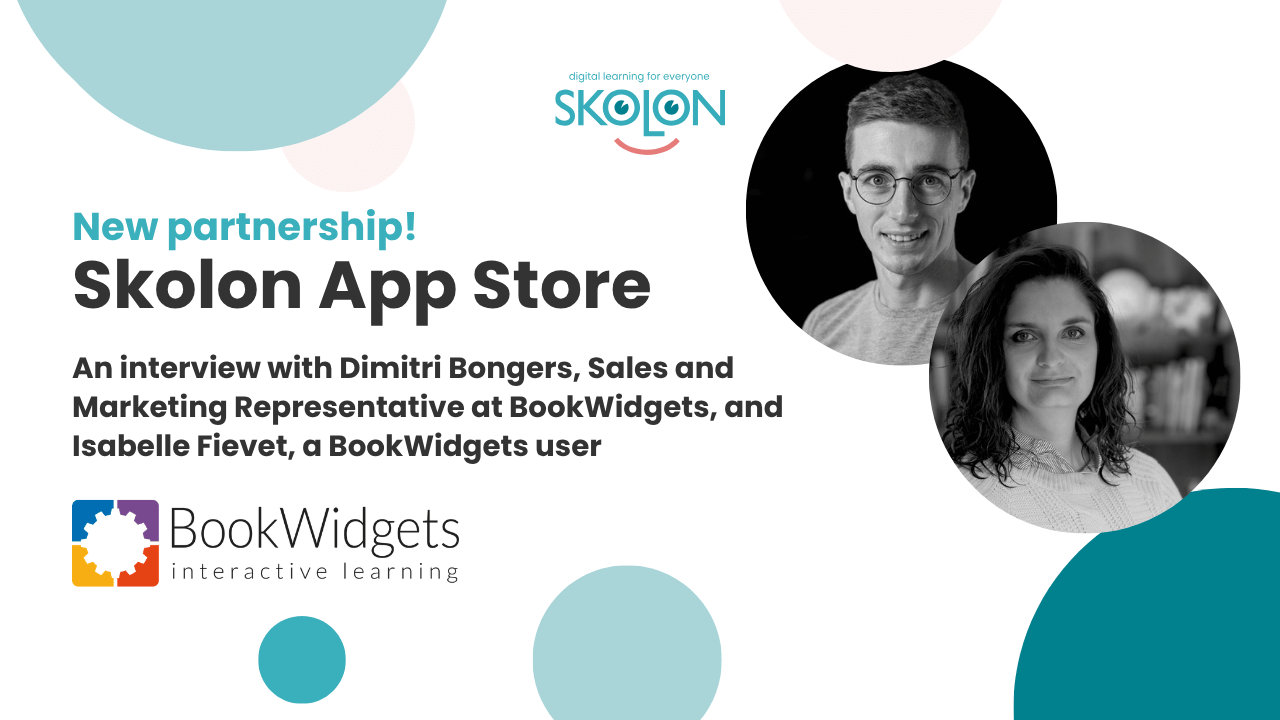
Digital transformation in schools is often a rocky road – characterised by red tape and the challenge of filtering out the genuinely useful tools from a sea of new options. In our latest partner interview, we spoke with Dimitri Bongers, the expert behind BookWidgets, and Isabelle, a passionate teacher and digital coach, about how to not just manage, but actively shape digital change in the classroom.
What exactly is BookWidgets?
Dimitri sums it up in a single sentence:
“BookWidgets is a content creation and assessment tool designed specifically for teachers.”
Essentially, BookWidgets can be likened to a Swiss Army knife for lessons. Instead of using ten different apps for quizzes, worksheets, crosswords, or interactive timelines, BookWidgets collates over 40 different exercise types together into one single platform.
The challenge: Real-time feedback
Isabelle, a former English teacher in Brussels, knows the problems of the analogue day-to-day all too well. Her biggest obstacle was time:
Marking workload: “It was simply too much work to mark everything by hand,” she recalls.
Delayed feedback: When students only get their marked tests back days later, the learning impact has often vanished.
This is where BookWidgets comes in. Thanks to the live feature, Isabelle can see in real time what her students are working on, who needs help, and where there are general gaps in understanding. The system automatically marks many of the tasks, meaning students receive instant feedback – the golden key to lasting learning success.
From “must” to “want”: Motivation through transparency
An interesting aspect of the conversation was dealing with teenagers. Isabelle notes with a smile that students often claim to have revised a lot, even when the results say otherwise.
“With digital analytics, they are more open to discussion. When they see the results in black and white, they are more likely to admit: Okay, I probably didn’t revise enough after all.”
Through BookWidgets, she was able to establish a system where students can repeat tasks until they reach a certain pass mark (e.g., 80%). Without the automated marking, this would be almost impossible for a teacher to manage.
Seamless integration into the school day
A key advantage of BookWidgets is its flexibility. It isn’t a rigid learning system; rather, it integrates seamlessly into existing Learning Management Systems (LMS) like Google Classroom, Microsoft Teams, or Moodle. As a result, teachers don’t have to leave their familiar digital environment. Furthermore, it’s suitable for every subject – from languages and maths to technical courses.
More time for what matters
At the end of the day, it’s not simply about replacing paper with screens. It’s about reducing the burden on teachers. Dimitri emphasises that the team behind BookWidgets has a strong background in education themselves. You can feel this practical connection: the tool saves time on admin and creates space for what really counts – the individual support of students.
Inclusion failure is often an access failure first
Interestingly, when digital inclusion breaks down, it’s rarely because a tool is missing. More often than not, barriers emerge because pupils cannot reliably log in, staff are forced to become the access workaround, systems are too complex for independent use, or digital confidence varies significantly between environments.
The result is a dependency model, where learners rely on others to access the resources they need rather than engaging independently. Across a trust, this approach is difficult to sustain and even harder to scale.
Complexity drives hidden operational risk
As ecosystems grow, so does the number of:
- user accounts
- authentication routes
- permission structures
- system entry points
Each additional layer increases administrative overhead, but more importantly, it reduces clarity.
For MAT leaders, this creates a simple but significant issue: You can’t govern what you cannot easily see, as without a unified access approach, you’ll be left managing a distributed system of controls that may behave differently across schools and platforms.
Which leads to… standardisation now becoming a strategic requirement
The most effective MATs are moving away from viewing access as a series of individual system decisions and are instead treating it as a trust-wide principle by design.
This means providing a consistent way for users to access digital tools; adopting a unified approach to identity and authentication, maintaining clear oversight of user access, and delivering a familiar experience across schools and settings. Importantly, though, this does not mean reducing flexibility in the tools schools choose to use. Rather, it means reducing variation in how those tools are accessed and managed, and that distinction matters.
Bringing consistency back into the system
This is where a joined-up approach becomes critical.
Skolon helps MATs standardise digital access across their estate by bringing tools, identities, and permissions into a single secure environment.
Rather than managing multiple disconnected entry points, trusts gain a consistent access layer across platforms and users.
The outcome is not fewer tools.
It’s fewer inconsistencies, fewer blind spots, and a more governable digital environment.
Because at trust level, inclusion is not just about what tools are available.
It is about whether everyone can access them in the same way, every time.
This is Skolon – we gather the best digital educational tools and make them work in the classroom.
Skolon is an independent platform for digital educational tools and learning resources, created for both teachers and students. With Skolon, accessing and using your digital educational tools is easy – security increases, administration decreases, and there’s more time for learning.
The digital educational tools come from both small and large providers, all of whom have one thing in common – they create digital educational tools that are beneficial for the school environment.
Information
Author: Amber Lovell
Share this story
Subscribe
Would you like our newest articles delivered to your inbox? Sign up now!
Digital transformation in schools is often a rocky road – characterised by red tape and the challenge of filtering out the genuinely useful tools from a sea of new options. In our latest partner interview, we spoke with Dimitri Bongers, the expert behind BookWidgets, and Isabelle, a passionate teacher and digital coach, about how to not just manage, but actively shape digital change in the classroom.
What exactly is BookWidgets?
Dimitri sums it up in a single sentence:
“BookWidgets is a content creation and assessment tool designed specifically for teachers.”
Essentially, BookWidgets can be likened to a Swiss Army knife for lessons. Instead of using ten different apps for quizzes, worksheets, crosswords, or interactive timelines, BookWidgets collates over 40 different exercise types together into one single platform.
The challenge: Real-time feedback
Isabelle, a former English teacher in Brussels, knows the problems of the analogue day-to-day all too well. Her biggest obstacle was time:
Marking workload: “It was simply too much work to mark everything by hand,” she recalls.
Delayed feedback: When students only get their marked tests back days later, the learning impact has often vanished.
This is where BookWidgets comes in. Thanks to the live feature, Isabelle can see in real time what her students are working on, who needs help, and where there are general gaps in understanding. The system automatically marks many of the tasks, meaning students receive instant feedback – the golden key to lasting learning success.
From “must” to “want”: Motivation through transparency
An interesting aspect of the conversation was dealing with teenagers. Isabelle notes with a smile that students often claim to have revised a lot, even when the results say otherwise.
“With digital analytics, they are more open to discussion. When they see the results in black and white, they are more likely to admit: Okay, I probably didn’t revise enough after all.”
Through BookWidgets, she was able to establish a system where students can repeat tasks until they reach a certain pass mark (e.g., 80%). Without the automated marking, this would be almost impossible for a teacher to manage.
Seamless integration into the school day
A key advantage of BookWidgets is its flexibility. It isn’t a rigid learning system; rather, it integrates seamlessly into existing Learning Management Systems (LMS) like Google Classroom, Microsoft Teams, or Moodle. As a result, teachers don’t have to leave their familiar digital environment. Furthermore, it’s suitable for every subject – from languages and maths to technical courses.
More time for what matters
At the end of the day, it’s not simply about replacing paper with screens. It’s about reducing the burden on teachers. Dimitri emphasises that the team behind BookWidgets has a strong background in education themselves. You can feel this practical connection: the tool saves time on admin and creates space for what really counts – the individual support of students.
Inclusion failure is often an access failure first
Interestingly, when digital inclusion breaks down, it’s rarely because a tool is missing. More often than not, barriers emerge because pupils cannot reliably log in, staff are forced to become the access workaround, systems are too complex for independent use, or digital confidence varies significantly between environments.
The result is a dependency model, where learners rely on others to access the resources they need rather than engaging independently. Across a trust, this approach is difficult to sustain and even harder to scale.
Complexity drives hidden operational risk
As ecosystems grow, so does the number of:
- user accounts
- authentication routes
- permission structures
- system entry points
Each additional layer increases administrative overhead, but more importantly, it reduces clarity.
For MAT leaders, this creates a simple but significant issue: You can’t govern what you cannot easily see, as without a unified access approach, you’ll be left managing a distributed system of controls that may behave differently across schools and platforms.
Which leads to… standardisation now becoming a strategic requirement
The most effective MATs are moving away from viewing access as a series of individual system decisions and are instead treating it as a trust-wide principle by design.
This means providing a consistent way for users to access digital tools; adopting a unified approach to identity and authentication, maintaining clear oversight of user access, and delivering a familiar experience across schools and settings. Importantly, though, this does not mean reducing flexibility in the tools schools choose to use. Rather, it means reducing variation in how those tools are accessed and managed, and that distinction matters.
Bringing consistency back into the system
This is where a joined-up approach becomes critical.
Skolon helps MATs standardise digital access across their estate by bringing tools, identities, and permissions into a single secure environment.
Rather than managing multiple disconnected entry points, trusts gain a consistent access layer across platforms and users.
The outcome is not fewer tools.
It’s fewer inconsistencies, fewer blind spots, and a more governable digital environment.
Because at trust level, inclusion is not just about what tools are available.
It is about whether everyone can access them in the same way, every time.
This is Skolon – we gather the best digital educational tools and make them work in the classroom.
Skolon is an independent platform for digital educational tools and learning resources, created for both teachers and students. With Skolon, accessing and using your digital educational tools is easy – security increases, administration decreases, and there’s more time for learning.
The digital educational tools come from both small and large providers, all of whom have one thing in common – they create digital educational tools that are beneficial for the school environment.
Share this story
Subscribe
Would you like our newest articles delivered to your inbox? Sign up now!