Cyber Essentials explained for education
Cyber Essentials is the minimum standard of cyber security recommended by the UK Government for organisations of all sizes. In the education sector, where schools and trusts are responsible for protecting sensitive pupil and staff data while managing increasingly complex digital environments, meeting these requirements has never been more important.
Read on to learn more about Cyber Essentials, why it matters for schools and multi-academy trusts, and how the right technology can help you strengthen your cyber security posture, simplify user access and support many of the controls outlined in the Cyber Essentials framework.


Cyber Essentials
What is it?
Cyber Essentials is a government backed scheme that was developed by the experts at the NCSC (National Cyber Security Centre) as a certification scheme aligned to five technical controls that are designed to prevent the most common internet based cyber security threats.
Cyber Essentials is both suitable (and essential) for schools and trusts of all sizes due to the amounts of information held, such as:
- Sensitive personal data
- Safeguarding records
- Financial information,
which increases the likelihood of becoming a prime target for cyber attacks.
Designed to be accessible and cost-effective, Cyber Essentials aims to provide a fundamental layer of defense that scales to fit the infrastructure, resources, and budget of any school or MAT.
By achieving the certification, schools and MATs can reassure parents, staff, and governing bodies that they take data protection seriously and have strong baseline defenses in place.
Cyber Essentials vs. Cyber Essentials Plus
What’s the difference?
The scheme offers two levels of certification to choose from, depending on the level of assurance an organisation requires:
Cyber Essentials
This is the first and most basic phase that is a standard level self-assessment process that schools and trusts can complete with a self-assessment questionnaire (SAQ) that details their current cyber security measures.
Once complete, the questionnaire gets independently reviewed by a qualified assessor.
Cyber Essentials Plus
This level includes the exact same self-assessment questionnaire, however, it also adds a rigorous, independent technical audit that will be conducted by an external, qualified assessor.
They will carry out vulnerability scans and physical or remote tests on your systems to verify that the security controls are not only self-reported, but actively functioning to defeat basic hacking and phishing attacks.
While it requires a greater investment of time and resources, it provides a significantly higher, verified level of assurance.
Cyber Essentials
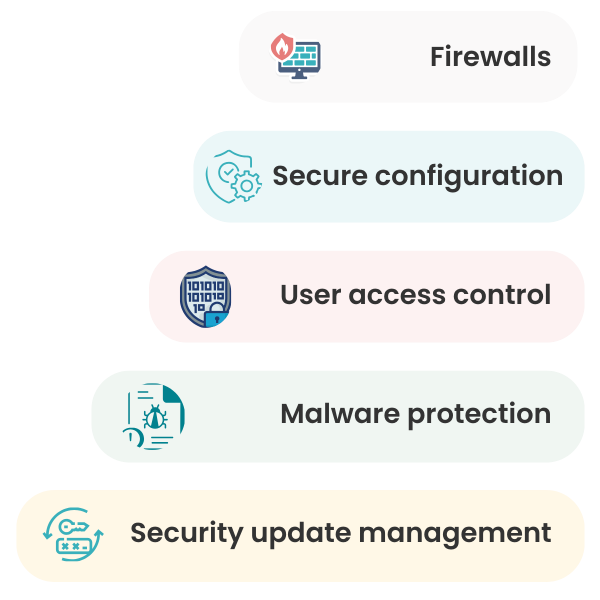
The five Cyber Essentials technical controls
Cyber Essentials isn’t just about achieving a certification. It’s about continuously putting practical, effective security measures in place to protect your school community, support safeguarding, reduce disruption and create a safer digital learning environment for everyone.
So, what does Cyber Essentials actually require? Let’s take a look at the five technical controls that form the foundation of the scheme.
Firewalls explained for schools and trusts: the first line of defence in Cyber Essentials
Firewalls are just one of the five technical controls that make up the UK’s Cyber Essentials scheme. They’re considered a fundamental part of protecting organisations from common cyber threats, including schools and multi-academy trusts.
Security update management
As one of the five Cyber Essentials controls, security update management ensures that software remains supported, patched and protected against known threats. Whether you’re managing an entire digital learning platform or individual classroom digital tools, keeping systems
current is essential.
How Skolon supports Cyber Essentials
Cyber Essentials is designed to help organisations put practical cyber security measures in place to protect against the most common online threats. While achieving Cyber Essentials certification depends on your school’s overall IT infrastructure, policies and processes, the technology you choose can play an important role in supporting many of the scheme’s requirements.
Skolon has been designed to simplify secure access to digital learning while helping schools and multi-academy trusts manage users, applications and identities more effectively. From reducing password fatigue to automating user provisioning, Skolon supports several of the principles that underpin Cyber Essentials.
Here’s how Skolon aligns with key areas of the framework:
| Cyber essentials area | How Skolon helps |
|---|---|
| User access control | Single Sign-On (SSO) provides one secure login to approved digital learning resources, reducing the number of usernames and passwords users need to manage. |
| Identity management | Integrates with Microsoft Entra ID, Google Workspace and your MIS to provide centralised identity management and consistent access across connected applications. |
| Managing joiners, movers and leavers | Automated user provisioning and synchronisation help ensure accounts are created, updated and removed efficiently as users join, change roles or leave the organisation. |
| Password security | By reducing the number of passwords users need to remember, SSO helps minimise password fatigue and encourages stronger security practices. For younger pupils, Skolon Pass enables secure QR code login, removing the need to remember complex passwords. |
| Secure access | Provides a central platform for accessing approved digital learning tools, helping schools maintain greater control over the applications available to staff and pupils. |
| Visibility and control | Gives IT teams a central view of user access and connected applications, making it easier to manage identities and support good access governance. |
Supporting a layered approach to cyber security
It’s important to note that Cyber Essentials isn’t just about implementing a single product. The framework takes a layered approach, combining secure technology, effective processes and user awareness to reduce cyber risk. It’s not ‘one and done’, nor is it about applying one tool for a quick fix.
Skolon complements a well-rounded approach by helping schools strengthen identity and access management, simplify authentication and improve control over digital learning resources. It works alongside firewalls, endpoint protection, security updates and other security measures to help create a safer, more manageable digital environment.
While Skolon doesn’t replace your school’s wider cyber security responsibilities, we can support many of the user access and identity management practices that contribute towards a stronger Cyber Essentials posture overall.
Cyber Essentials checklist for schools
Wondering where your school or trust stands? While Cyber Essentials certification requires a formal assessment, asking yourself a few simple questions can help you identify areas for improvement.
Use this quick checklist to assess whether your organisation is following some of the key principles of Cyber Essentials.